Home / Services / Panel Recycling
Panel Recycling
Solar is clean energy. Panel disposal should be too
Australia installed millions of solar panels over the past 15 years, and the first wave is now reaching end of life. What happens to them matters enormously. At SolBuddy, we are committed to keeping panels out of landfill — recovering the valuable materials inside and giving every component the best possible second life. Clean energy deserves a clean ending.
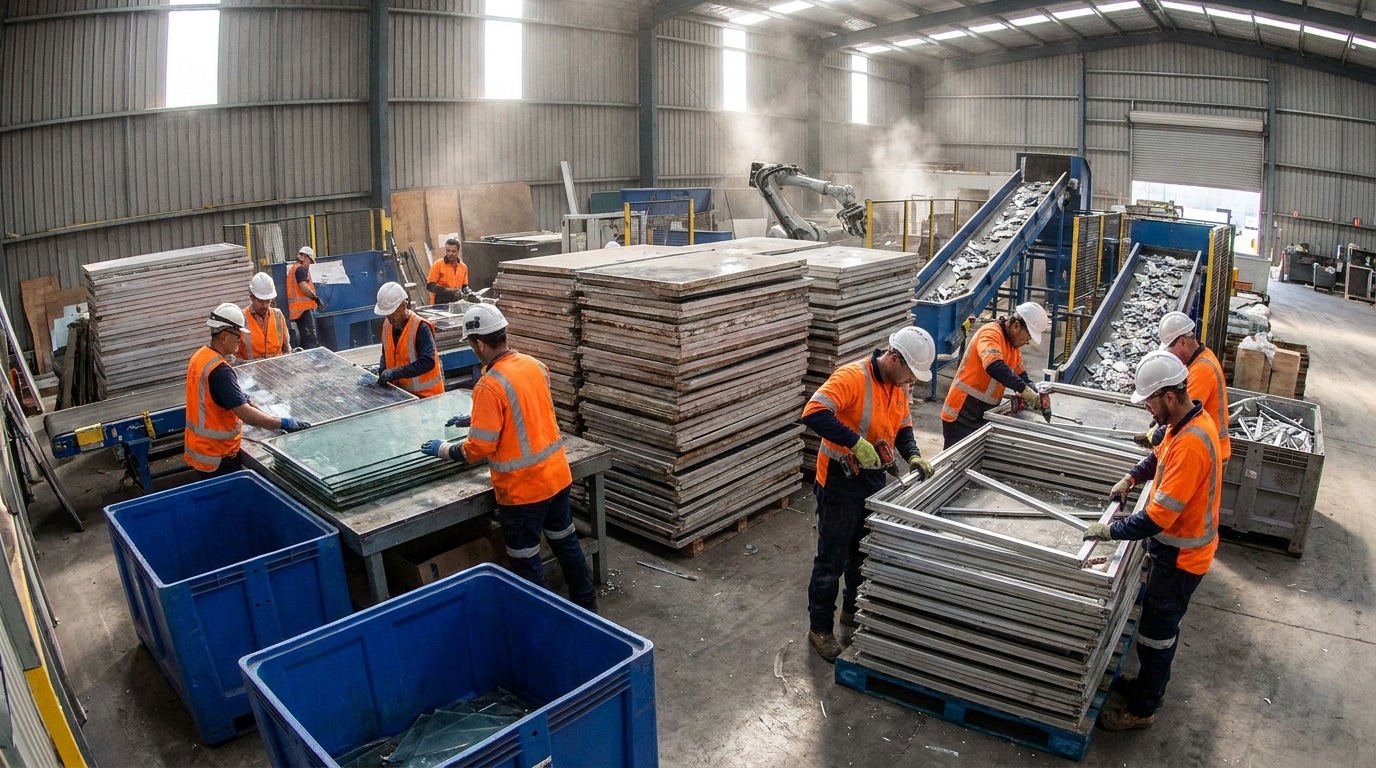
A standard solar panel contains glass, aluminium, copper wiring, a thin layer of silicon, and a small amount of silver — all valuable, all recoverable. It also contains trace amounts of lead in some older solder formulations. Left in landfill, that lead leaches slowly into soil and groundwater. Recovered and reprocessed, it becomes raw material for new panels, windows, and electrical components.
Australia is expected to generate around 100,000 tonnes of end-of-life solar panels by 2035. The decisions we make now about recycling infrastructure will determine whether that wave of material is an environmental liability or a domestic resource. SolBuddy is proud to be part of the solution.
What is actually inside a solar panel?
Understanding what panels are made of helps explain why recycling them is worth the effort. A typical silicon photovoltaic panel consists of around 76% glass by weight, 10% aluminium framing, 8% encapsulant polymer, 5% silicon cells, and smaller amounts of copper, silver, tin, and lead. The glass and aluminium alone are highly valuable if they can be cleanly separated.
- Glass (76%): recovered and used in flat-glass manufacturing, road base aggregate, or new panel production.
- Aluminium frame (10%): melted down and recycled into new aluminium products — one of the most energy-efficient recycling processes there is.
- Silicon cells (5%): cleaned and reprocessed into silicon feedstock for new semiconductor and solar applications.
- Copper and silver wiring: recovered via thermal or chemical processes and returned to the metals supply chain.
- Polymer backsheet and encapsulant: more challenging to recover but increasingly processed into fuel or inert aggregate rather than being landfilled.
When should you recycle panels, and when are they still useful?
Not every old panel needs to go straight to a recycler. Panels degrade slowly — most lose only 0.5 to 1% of their rated output per year. A 25-year-old panel might still be producing at 75 to 80% of its original capacity. In many situations, those panels have a useful second life: rural off-grid systems, community garden pumps, humanitarian aid projects, and school science programmes all find value in panels that no longer meet commercial performance standards.
Our first step is always to assess whether your retiring panels can be redeployed. If they can, we work with our community partners to find a good home. If they are genuinely at end of life — cracked cells, delamination, broken glass — they go to our certified recycling stream.
How the recycling process works
Our panel recycling is carried out by accredited Australian facilities that are compliant with the National Television and Computer Recycling Scheme (NTCRS) standards and aligned with the emerging Product Stewardship framework for photovoltaics. Here is what the process looks like from your side:
- You book a collection through SolBuddy — we arrange removal from your rooftop or storage and handle all transport logistics.
- Panels arrive at our recycling partner facility, where they are logged, photographed, and assessed for reuse or recycling.
- Reusable panels are tested, cleaned, and transferred to our community reuse programme.
- Panels destined for recycling go through mechanical dismantling: the aluminium frame and junction box are removed first.
- The panel laminate is processed — thermal or chemical treatment separates the glass from the cell material and backsheet.
- You receive a waste diversion certificate confirming your panels were handled responsibly, suitable for corporate sustainability reporting.
Photon's tip: if you are upgrading your system, ask your new installer to include old-panel disposal in the project quote. Many will coordinate collection at the same time as installation, saving you a separate logistics step.
The circular economy case for solar
The circular economy is the idea that materials should cycle continuously through the economy rather than flowing linearly from resource to product to waste. Solar panels are a natural fit for this thinking: the silicon in your current panels could, in principle, end up in the next generation of panels installed on someone else's roof.
Several manufacturers are already designing 'design for disassembly' panels that use mechanical fasteners instead of adhesive laminates, making future recycling far easier and more cost-effective. At SolBuddy, we track these developments closely and will always recommend products that consider end-of-life when that information is available.
What about the environmental cost of recycling itself?
It is a fair question. Recycling is not free — it requires energy and transport. But the lifecycle analysis is clear: the carbon cost of recycling a panel is a tiny fraction of the emissions saved by the clean electricity it generated during its working life. And by recovering silicon, silver, and glass, recycling reduces the mining and manufacturing burden for the next generation of solar technology.
As Australian recycling volume grows, the economics improve further. Higher throughput means lower per-panel processing costs, which in turn means less subsidy or fee is needed to make responsible recycling the default choice. Every panel you send to us rather than landfill makes the system work better for everyone who comes after you.
Frequently asked questions
Is it illegal to put solar panels in a regular skip or council bin?
Solar panels are classified as e-waste in most Australian states and territories, which means they cannot legally go into general waste or a standard skip. ACT, Victoria, and Western Australia have explicit e-waste bans that cover solar panels. Even where it is not yet an offence, it is poor practice — responsible disposal is straightforward and increasingly low-cost.
How much does panel recycling cost?
Costs vary depending on quantity, location, and current commodity prices. As a rough guide, residential customers can expect $5 to $15 per panel for certified collection and recycling, which often works out to $150 to $400 for a typical 20-panel system being replaced. We provide a firm quote before any work begins.
Can I donate my old panels instead of recycling them?
Absolutely, and this is our preferred first step. If your panels still produce usable power, we can connect you with community organisations, rural properties, and humanitarian programmes that would put them to good work. We assess suitability at no charge.
Do new solar panels come with a take-back scheme?
A small number of premium manufacturers operate voluntary take-back programmes. A mandatory Australian product stewardship scheme covering solar panels is in active development and is expected to be legislated within the next few years. We will update our services as those schemes launch.
What documentation do I get for corporate or council sustainability reporting?
We provide a waste diversion certificate that records the panel serial numbers, total weight diverted from landfill, and the recycling facility details. This is suitable for use in National Greenhouse and Energy Reporting (NGER) documentation and most sustainability frameworks.
Let's go solar
Ready to make friends with the sun?
Get a free, no-pressure quote and a clear plan. Photon will walk you through every step — no jargon, promise.