Home / Services / Solar Maintenance
Solar Maintenance
Your solar works hard — we make sure it keeps doing so.
A solar system is a set-and-forget investment — up to a point. Panels accumulate dust and grime. Wiring and connectors age. Inverters occasionally throw fault codes. Without periodic checking, a system that looks fine from the street can be quietly underperforming by 10, 20, or even 30 per cent. SolBuddy's maintenance service finds and fixes those losses before they cost you money.
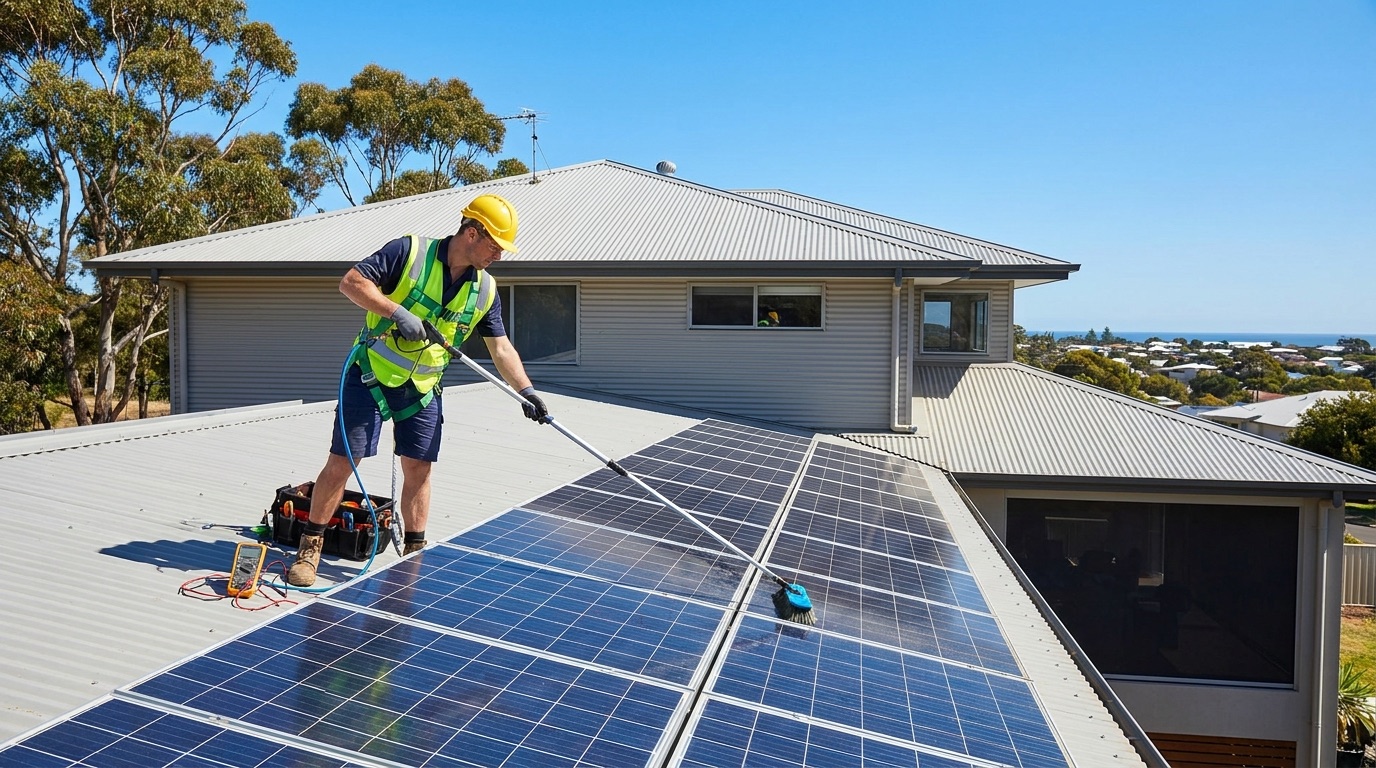
Solar panels have no moving parts, which makes people assume they never need attention. In reality, a solar system is an outdoor electrical installation exposed to sun, rain, heat, cold, wind, and animals for 25 years. Every one of those factors degrades performance over time. Regular maintenance is what separates a system that delivers on its financial promise from one that quietly delivers less and less while the bills creep upward.
SolBuddy offers scheduled maintenance plans, one-off inspection and service visits, and emergency fault response for residential and commercial solar systems across our service regions. Every maintenance visit is performed by a licensed electrician or Clean Energy Council accredited installer — not an unskilled labourer with a hose. We leave you with a written report and, where we find issues, a clear quote for remedial work.
What degrades a solar system over time?
Panel soiling is the most common cause of generation loss. Dust, bird droppings, pollen, pollution, and salt air all deposit on panel surfaces and block incoming light. The degree of soiling loss varies by location — in dry inland areas it can be significant in just a few weeks without rain; in coastal areas salt spray builds up slowly but is particularly stubborn. Studies in Australian conditions consistently show soiling losses of 3 to 15 per cent in typical environments, rising higher in dusty or agricultural settings.
Beyond soiling, a comprehensive inspection looks at electrical degradation that is invisible from the ground but has real performance consequences.
- Micro-cracks in panel cells: caused by thermal cycling and physical stress, they reduce cell output and can develop into hotspots that accelerate further damage
- PID (Potential Induced Degradation): a voltage-related degradation mode that can cut panel output by 20 per cent or more if not addressed — most common in older string inverter systems
- Connector oxidation and corrosion: MC4 connectors on the DC wiring that joins panels together can oxidise over time, increasing resistance and creating hotspots
- Inverter performance drift: inverters can run below peak efficiency due to firmware issues, faulty Maximum Power Point Tracking, or internal component degradation
- Roof penetration and racking integrity: mounting hardware can corrode, fasteners can loosen, and roof penetrations sealed with incorrect materials can develop leaks over time
Photon's tip: the quickest way to spot if your system is underperforming is to compare your current daily generation average — visible in your inverter app — to the generation figures in your original installation quote. If you're consistently 15 per cent or more below the estimate after adjusting for recent weather, a service visit is likely to pay for itself.
What a SolBuddy maintenance visit includes
Our standard residential service visit covers a complete inspection of every accessible component. On the roof, we clean all panels with deionised water and appropriate brushes, inspect mounting hardware and roof penetrations, look for visible cell damage or discolouration, and check that all wiring and connectors are properly secured and protected. At the inverter, we check for fault logs, test DC and AC input and output voltages and currents, verify that all Maximum Power Point Trackers are operating correctly, and update firmware if an update is available.
We also check the switchboard isolators, AC protection devices, and earthing connections. If you have a battery, we test the battery management system, check cell balance data, and verify that all battery protection settings are within the manufacturer's specifications. The whole visit typically takes two to four hours for a residential system. At the end we provide a written report with photographs of any issues found, a health rating for the system, and recommended actions prioritised by impact.
Thermal imaging for hidden faults
SolBuddy's premium inspection service includes thermal imaging of the panel array using a FLIR-class infrared camera. Thermal imaging reveals hotspots caused by micro-cracking, shading mismatch, bypass diode failures, and soiling patterns that are invisible to the eye in normal light. A hotspot that reads 20–30 degrees above the surrounding panel surface indicates a fault that is actively degrading that panel and, in worst cases, poses a fire risk. Thermal imaging allows us to identify and replace faulty panels before they cause wider system damage or become a safety issue.
Maintenance plans: scheduled care vs ad-hoc
We offer two service models. Our annual maintenance plan includes one full service visit per year, priority scheduling for fault response, and a 10 per cent discount on any repair work identified during the visit. The plan is priced by system size and typically costs $250 to $450 per year for a residential system. This is the approach we recommend: scheduled maintenance means faults are caught early when they are cheap to fix, and you are never caught with a broken system at the peak of summer.
We also accept one-off service bookings for customers who prefer to manage their own maintenance schedule, or who have purchased or inherited a system from a previous owner and want to understand its current condition. One-off visits are priced at $350 to $600 for a typical residential system depending on size and location, including the written report. If you want to add thermal imaging, that is an additional $150 to $250.
Monitoring: the maintenance that never stops
The best complement to periodic in-person maintenance is continuous remote monitoring. Modern inverters from Fronius, SolarEdge, SMA, and Enphase all offer cloud monitoring that logs generation data at five-to-fifteen-minute intervals and sends alerts for fault conditions. We configure monitoring for every system we install and can also set it up for existing systems. With monitoring in place, you will know within hours if a string goes down or an inverter faults — rather than finding out at the end of the quarter when you open a surprisingly large electricity bill.
SolBuddy also offers a remote monitoring subscription service for commercial customers: we watch your system's daily generation data against expected output and alert you proactively if performance drops below threshold. For large commercial systems where a single day of underperformance can mean hundreds of dollars in lost solar value, this kind of active monitoring delivers genuine peace of mind and fast fault resolution.
Frequently asked questions
How often should I have my solar system professionally serviced?
We recommend a full service every one to two years for most residential systems. In dusty, agricultural, or coastal environments we suggest annual visits. Commercial systems with larger financial stakes generally benefit from annual maintenance as a minimum. The first service is most valuable about two years after installation, when any installation defects have had time to manifest and the system's real-world performance can be benchmarked against the original design.
Can I clean my own solar panels?
Yes, with a few important caveats. Never use tap water — the minerals it contains leave residue that accelerates soiling. Use deionised or demineralised water and a soft brush or squeegee. Never use abrasive materials or high-pressure water, which can damage panel surfaces and drive water into connectors. And critically — never go on the roof without appropriate fall protection equipment and harness. Many solar-related injuries each year happen to homeowners cleaning their own panels. Our professional clean costs less than a hospital visit.
My inverter is showing a fault code — what should I do?
Note the fault code and take a photo of the inverter display. Check whether the inverter's monitoring app gives you more detail on the fault. Many inverter faults are transient — caused by a grid voltage spike or a momentary communication dropout — and clear themselves after a reset. If the fault recurs after a restart, call us. We can often diagnose the issue remotely from the monitoring data before attending site, which saves time and cost.
My energy bills have gone up but my panels look clean. What could be wrong?
Several things can reduce generation without being visible from the ground: micro-cracking in panel cells, a string of panels with a shading issue that wasn't present when the system was installed (perhaps from a new tree or structure), a faulty bypass diode, or an inverter running below optimal efficiency. Our maintenance visit with thermal imaging is designed exactly for this situation — we will find the cause and quantify the generation loss so you know what you are dealing with.
My solar system was installed by a company that has since closed down. Can SolBuddy service it?
Absolutely. We service systems from all manufacturers and from all installers, regardless of who put them in. We will need the system documentation if you have it — inverter brand and model, panel brand and specifications, system size — but we can also work from a site inspection if paperwork is unavailable. Orphaned systems are something we see regularly and we are well set up to take over their care.
Let's go solar
Ready to make friends with the sun?
Get a free, no-pressure quote and a clear plan. Photon will walk you through every step — no jargon, promise.